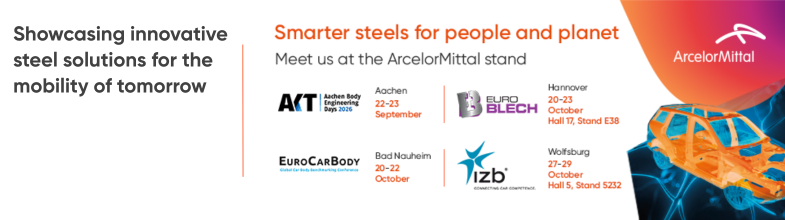

Berlin, 19 October 2026 – ArcelorMittal is presenting innovative steel solutions for the automotive industry at three major German industry events this October: at EuroCarBody 2026 from 20 to 22 October in Bad Nauheim, at EuroBLECH 2026 from 20 to 23 October in Hanover, and at the International Suppliers’ Fair (IZB) 2026 from 27 to 29 October in Wolfsburg.
The focus of the exhibition stand will be on advanced steel concepts for body-in-white, battery packs and chassis applications. In doing so, ArcelorMittal will demonstrate how modern steel materials and innovative component concepts can help make vehicles lighter and their production more efficient and resource-friendly.
With its solutions, ArcelorMittal combines material development and innovative vehicle design with more efficient manufacturing. This is not just about individual steel grades, but increasingly about holistic solutions that bring together component consolidation, weight optimisation, safety, manufacturing efficiency and CO₂ reduction. “The demands on the automotive industry are changing rapidly. With solutions such as Multi Part Integration®, we are demonstrating the potential offered by modern steels: fewer components, less material, lower weight and simpler production, whilst still meeting high standards of safety and performance. Together with our customers, we want to harness this potential to make the mobility of tomorrow more efficient and sustainable,” says Paul Brettnacher, Chief Marketing Officer for the Automotive division at ArcelorMittal Europe Flat Products.
One key focus is ArcelorMittal Multi Part Integration® (MPI). The concept combines several body components – previously manufactured separately – into a single large, laser-welded blank. This significantly reduces the number of individual parts and joining operations. MPI can be used for various powertrain concepts, ranging from internal combustion engines and hybrids to battery-electric vehicles, as well as for body-in-white, battery pack and chassis applications.
Specific studies by ArcelorMittal demonstrate the potential this holds: By combining MPI applications, the number of body components under consideration was reduced from 59 to 13. At the same time, 567 spot welds were eliminated. In the vehicle concept studied, 31.9 kilograms less material was used, whilst the weight of the finished components fell by 13.9 kilograms, or ten per cent. Material utilisation rose from 70 to 75 per cent.
There are also benefits in production. In the scenario examined, which involved extensive MPI integration, potential savings of up to 24 per cent fewer robots, 14 per cent less body shop floor space, eight per cent fewer operators and nine per cent lower investment costs were identified. The weight saving also helps to improve the carbon footprint, as less material is required. A specific example from an ArcelorMittal study on a double-door ring shows a reduction in component mass of 9.8 kilograms, or 10.7 per cent, per vehicle, as well as a reduction in raw material requirements of 22 kilograms, or 16.4 per cent. The associated life-cycle assessment also shows a reduction in CO₂ equivalents for this application.
Another example is Usibor® 1500, based on XCarb® recycled and renewably produced steel. XCarb® recycled and renewably produced is manufactured using a high proportion of steel scrap and renewable electricity. For relevant XCarb® products, ArcelorMittal cites a potential reduction in the CO₂ footprint of up to 75 per cent compared with the conventional blast furnace route.
The combination of high-strength steels and intelligent component design thus makes it possible to focus on the vehicle’s material efficiency as well as on emissions from steel production. MPI can also be combined with high-strength press-hardening steels and different material thicknesses, and aims to combine weight reduction with crash performance.
The portfolio is complemented by MartINsite® steels from ArcelorMittal. These are used, amongst other things, in applications where high strength and reliable protection are crucial, such as in safety bumpers and for the protection of battery packs in electric vehicles. ArcelorMittal is thus specifically targeting applications where the vehicle structure must meet high mechanical requirements whilst being designed to be as weight-optimised as possible. ArcelorMittal’s latest trade fair information explicitly cites safety bumpers and the protection of battery packs as areas of application for MartINsite®.